Story: Regional Health and Longevity
How geographic environment and lifestyle shape a Golden Retriever’s life
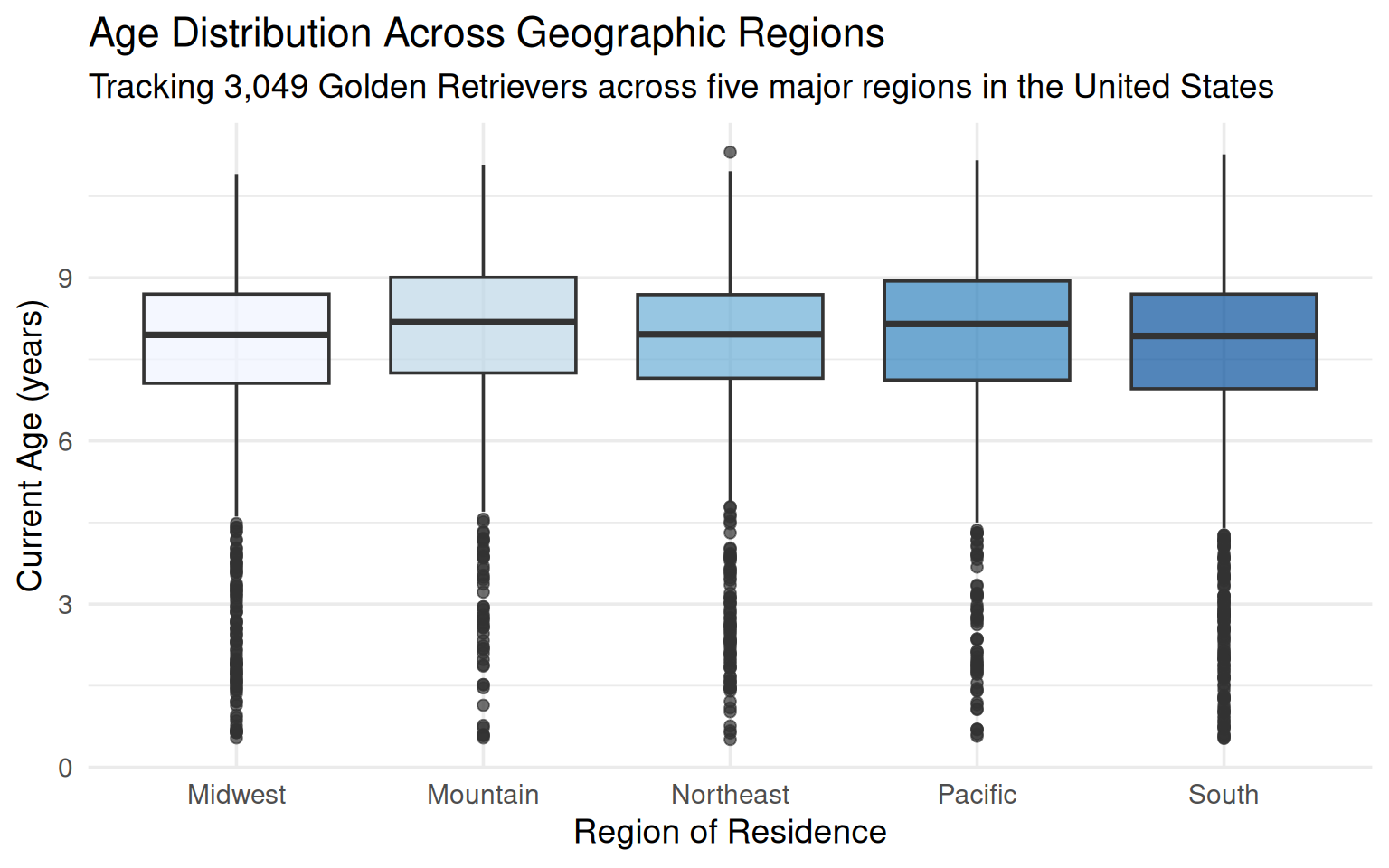
When looking at factors influencing a Golden Retriever’s health, geographic environment and lifestyle play a substantial role. Across 3,049 dogs in the Morris Animal Foundation Golden Retriever Lifetime Study, dogs are tracked across five key regions—Midwest, Mountain, Northeast, Pacific, and South.
Dogs in the Mountain and Pacific regions show slightly higher median ages (8.2 and 8.1 years) compared to dogs in the South and Midwest (7.9 years). Researchers are actively investigating how regional climates, outdoor exercise habits, and environmental exposures interact with canine genetics.
Fascinating Facts About Golden Retrievers
Note1. Scottish Highland Origins
The breed originated in 1868 in the rugged Scottish Highlands. Dudley Marjoribanks (Lord Tweedmouth) crossed a Yellow Retriever named “Nous” with a Tweed Water Spaniel named “Belle” to produce swimming, resilient gundogs suited for retrieving waterfowl across land and cold rivers.
Tip2. The Legendary “Soft Mouth”
Golden Retrievers were bred with such gentle jaw control that they can comfortably carry a raw egg in their mouth without breaking it. This trait was essential so they could retrieve game birds without damaging them.
Important3. Emotional Radar and Empathy
Goldens possess an extraordinarily high sensitivity to human vocal tones and emotional cues. Combined with their eager-to-please temperament, this makes them the world’s #1 breed for guide work, medical alert, and emotional therapy.
Caution4. The Geographic and Environmental Dimension
As research from the Golden Retriever Lifetime Study highlights, regional lifestyles and environmental exposures contribute significantly to health trajectories, leading scientists to study how different climates and outdoor habitats impact canine longevity.
Warning5. The Morris Lifetime Study & Lifespan Research
The Morris Animal Foundation Golden Retriever Lifetime Study has tracked over 3,000 Golden Retrievers to investigate why the breed’s average life expectancy has fallen from 16–17 years decades ago to 10–12 years today. With cancer accounting for roughly 75% of deaths in the cohort, the landmark study focuses on risk factors across genetics, lifestyle, and early detection.